Psychometric Analysis Using Item Response Theory (IRT)
Project Overview
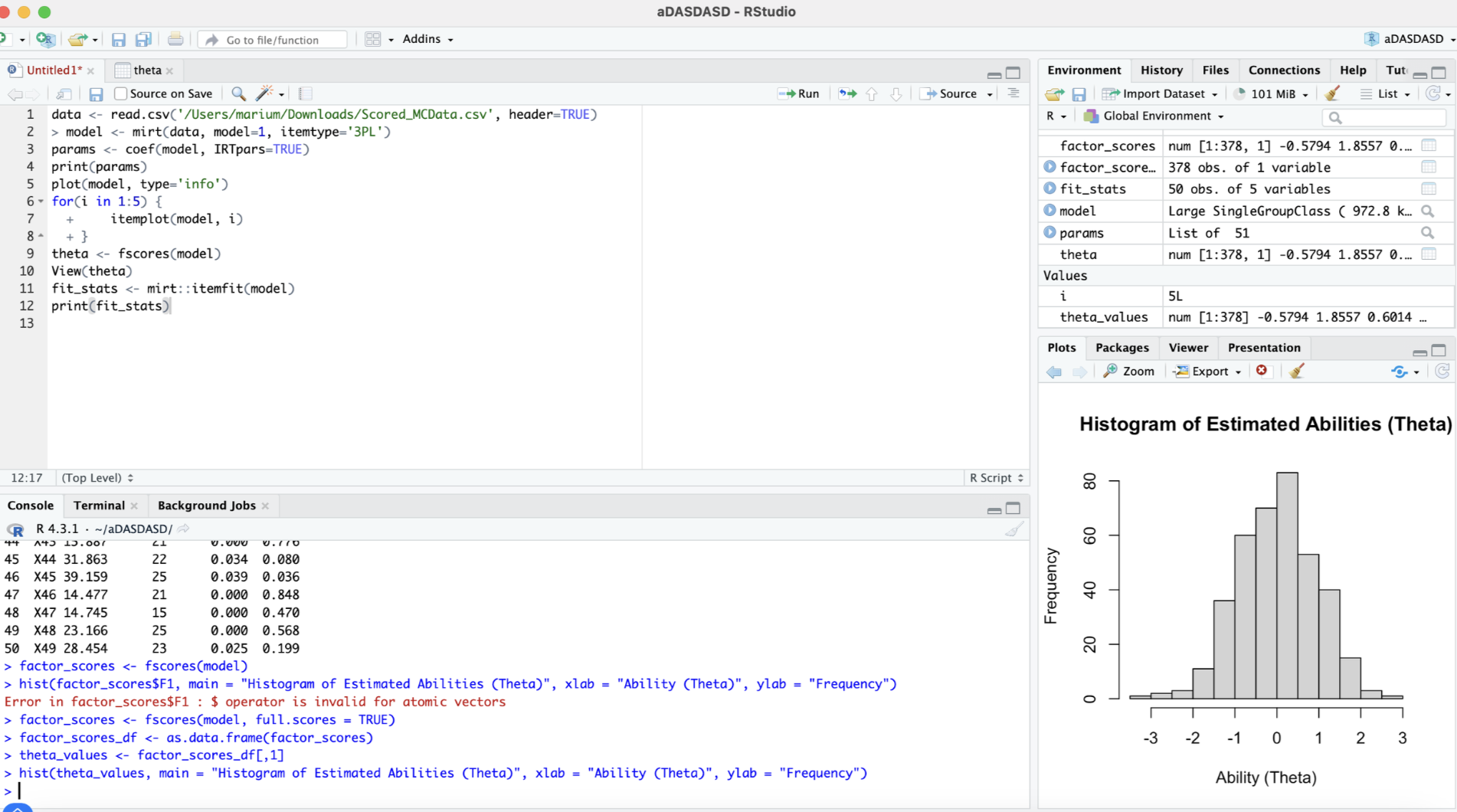
This project involved conducting a comprehensive psychometric evaluation using the Item Response Theory (IRT) framework. The aim was to estimate and analyze the abilities of participants within a given dataset, employing the 3-parameter logistic (3PL) model.
Objectives
- To determine the latent traits of individuals from their responses to a series of test items.
- To estimate item parameters that describe the difficulty, discrimination, and guessing factors of test items.
- To visualize the distribution of participant abilities and interpret the underlying patterns.
Methodology
1. Data Preparation: Data was imported from a CSV file into R, ensuring correct encoding and integrity of the dataset.
2. Model Construction: Utilized the mirt package in R to construct a single-factor IRT model applying the 3PL specification.
3. Parameter Estimation: Extracted item parameters to understand item characteristics and their impact on the measurement scale.
4. Ability Estimation: Computed factor scores (theta values) for each participant to estimate individual abilities.
5. Visualization: Generated a histogram to visualize the distribution of estimated abilities, providing a clear picture of the population's traits.
Challenges and Solutions
- Encountered and resolved a data structure issue by converting factor scores from atomic vectors to a data frame format.
- Debugged and corrected errors in visualization code to produce an accurate histogram of the abilities.
Results
The analysis successfully rendered a histogram of estimated abilities, indicating a normal distribution of abilities across the sample. The item characteristic curves plotted for the first five items provided insights into the quality of the test items and their performance.
Conclusion
The project showcased the ability to handle complex statistical modeling in R and demonstrated the application of IRT in measuring latent psychological constructs. The results provided valuable insights into the assessment's quality and the distribution of abilities among the test-takers.